This post is for IT, operations and team leads who want a structured way to judge how well their Microsoft 365 shared mailboxes are run. It explains what SMAF defines, why it puts structure before automation and AI, how teams use it, and what makes it a vendor-neutral reference rather than a product pitch.
Introduction
Shared mailboxes are one of the most common and most misunderstood collaboration tools in Microsoft 365. Addresses such as info@, support@, claims@, and sales@ often serve as the primary entry point for customers, partners, and internal teams. As organizations grow, these mailboxes absorb increasing volume, complexity, and urgency.
What begins as a simple shared inbox frequently evolves into a source of missed messages, duplicate responses, unclear accountability, and operational blind spots. Teams often react by working harder, adding more rules, or migrating to entirely new platforms. These responses rarely address the underlying issue: the absence of a shared, structured model for how shared mailbox workflows mature over time.
Other disciplines solved this long ago. Security has NIST. IT service management has ITIL. Software development has CMMI. These frameworks describe capability levels independent of any single company's product, which is why a security team can use the NIST Cybersecurity Framework to evaluate tools from a dozen different vendors without the framework ever tilting the scorecard. Shared mailbox management never had an equivalent. Teams have plenty of vendor pitch decks explaining why they need a given tool, but very few independent ways to answer a more basic question first: what does "good" actually look like here, regardless of which tool we end up using?
The Shared Mailbox Automation Framework (SMAF) was created to address that gap.
Why shared mailbox workflows break down
Most shared mailbox problems are not caused by email itself. They stem from how responsibility, time, and visibility are organized around incoming messages.
At lower levels, shared mailboxes rely on informal coordination. Team members check the inbox when they have time, respond to familiar requests, and assume someone else will handle the rest. At low volume, this may function adequately. As volume increases, the cost of ambiguity rises.
Organizations often attempt to compensate with Outlook rules, folders, or informal conventions. These tactics add surface-level structure but rarely introduce true ownership or accountability. Messages are sorted, but not actively managed. Performance is discussed, but not systematically measured.
These problems are unusually easy to misdiagnose as tooling problems when they are actually structural. A team with unclear ownership, no time-based accountability, and no visibility into workload distribution will struggle no matter which inbox software sits on top of it. Conversely, a well-structured team can operate reasonably well even with fairly basic tools. Without a clear progression model, teams mix incompatible approaches, introducing automation before ownership exists, or adding AI before workflows are measurable. SMAF provides a logical sequence for improvement rather than a reactive collection of fixes.
What the Shared Mailbox Automation Framework defines
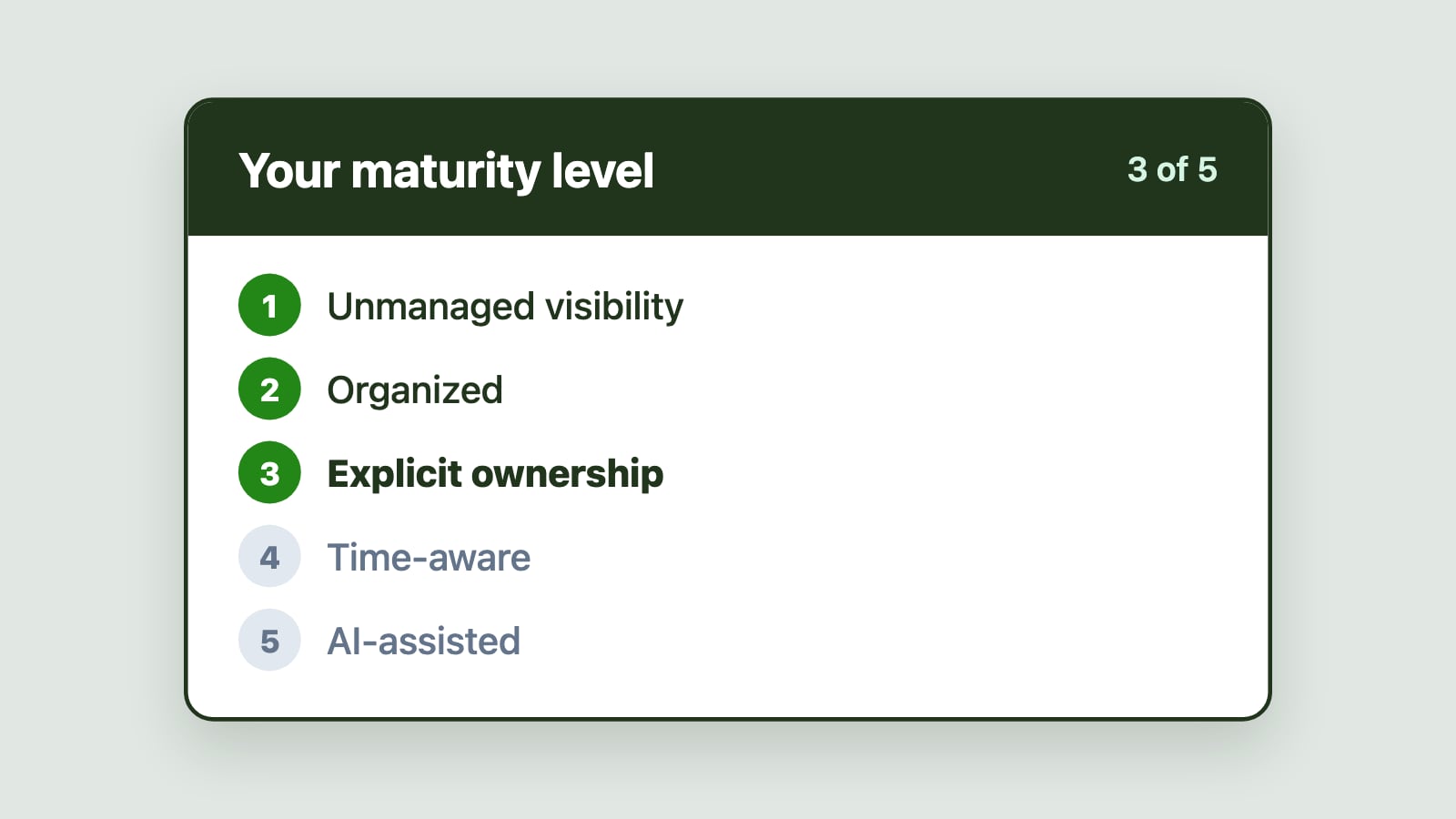
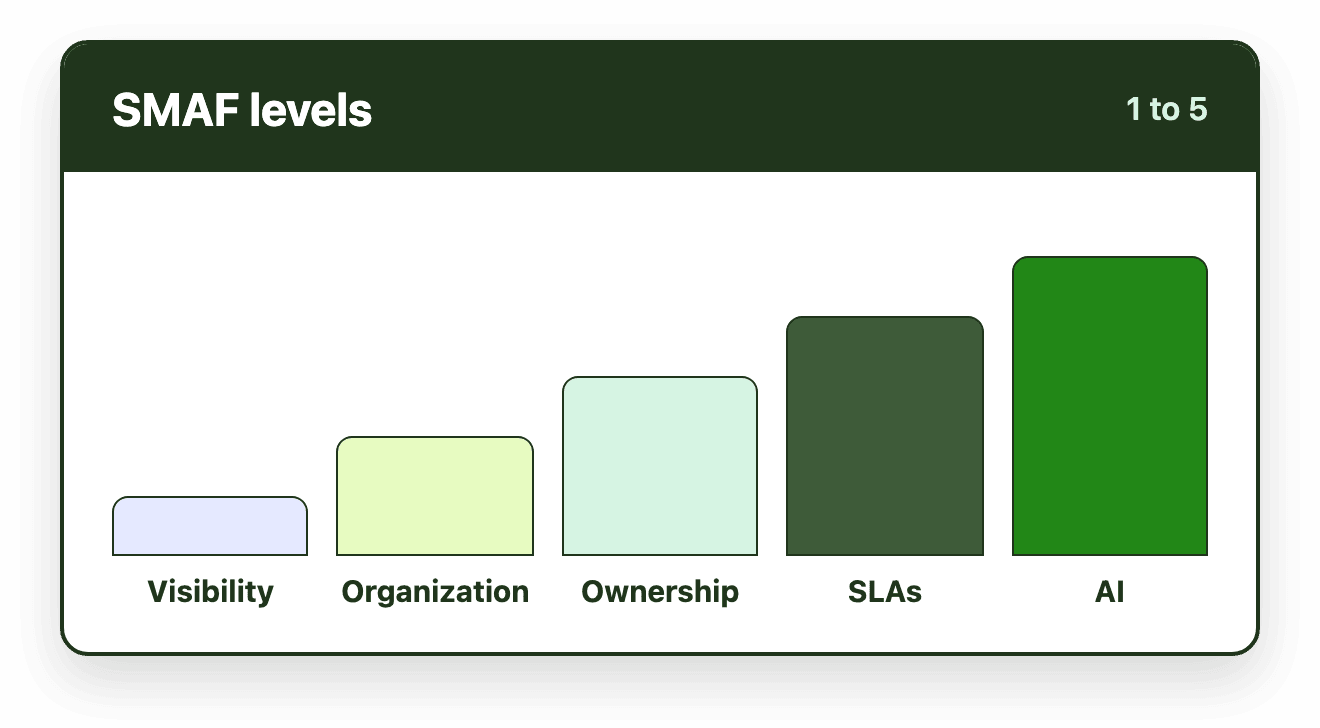
The Shared Mailbox Automation Framework is a maturity model that describes how shared mailbox workflows evolve. It defines five distinct levels, from reactive and informal coordination at one end to structured, accountable, and AI-assisted workflows at the other. Each level is characterized by specific capabilities, constraints, and operational behaviors.
SMAF focuses on capabilities rather than tools: is there a clear owner for every message, are response times measured and enforced, is workload distributed by rule rather than by memory. Two organizations can use the same technology yet operate at very different levels of maturity depending on how ownership, routing, and accountability are structured.
At its core, the framework answers three questions. What level is our shared mailbox workflow currently at? Which capabilities are missing at this level? What must change structurally before improvement is possible?
By separating effort from capability, SMAF clarifies that progress does not come from working harder inside the same structure. Advancement requires structural change. Understanding shared mailbox maturity levels in detail provides a practical starting point for applying the framework.
Why maturity matters more than volume
Shared mailbox challenges are often attributed to scale. In reality, maturity is more decisive than message count.
A low-volume mailbox without clear ownership can present greater operational risk than a high-volume mailbox supported by structured workflows and accountability. Adding staff or rules to an immature system frequently increases complexity without improving outcomes.
SMAF reframes improvement around responsibility and time management rather than volume alone. This shift enables predictable progress instead of reactive adjustments.
Structure before automation
A foundational principle of SMAF is that structure must precede automation.
Automation applied to an unstructured workflow tends to amplify weaknesses. Rules can sort messages, but they cannot create accountability. Dashboards can display response times, but they cannot establish ownership. AI can suggest replies, but it cannot compensate for undefined priorities or unclear responsibilities.
SMAF intentionally places explicit ownership and queue-based coordination before time-based accountability and optimization. This sequencing reflects how shared mailbox workflows actually function in practice.
Where AI fits within the framework
AI is increasingly associated with email management. Within shared mailboxes, however, AI delivers the most value after core structural capabilities are in place.
At higher maturity levels, AI can assist with summarization, suggested replies, and pattern recognition. These enhancements reduce cognitive load and improve consistency. When introduced too early, AI operates on incomplete signals and limited structure.
SMAF helps organizations position AI realistically: as an optimization layer rather than a foundational solution.
Why SMAF is vendor-neutral
Maturity models are supposed to tell you the truth about where you stand. Too often, they are quietly built to tell you where you stand relative to a purchase. A framework that defines its highest stage as "has bought the vendor's premium tier" is not measuring maturity; it is measuring position in a sales funnel. Shared mailbox management, an area with no shortage of vendors and almost no independent standards, is a good example of why that distinction matters.
Why vendor-authored maturity models deserve scrutiny
A maturity model is not hard to reverse-engineer from a product roadmap. Start with the features you sell, arrange them from "basic" to "advanced," and label the stages. The result looks credible. It has levels, it has a nice diagram, and it makes intuitive sense. It also, not coincidentally, concludes that the way to reach the top stage is to buy the product that produced the model.
That is not automatically dishonest. A vendor's product often does reflect real expertise about what mature workflows require. But a model built this way cannot be trusted to hold up under a simple test: would it still make sense if you used it to evaluate a competitor?
What makes a framework genuinely vendor-neutral
A vendor-neutral framework passes that test because of how it is built, not because of who publishes it. Three things tend to separate a real framework from a repackaged feature list.
- It describes required capabilities, not product features. Instead of "has automated routing rules," a neutral framework says something like "incoming messages are assigned to an owner before anyone responds," which any tool, or no tool at all, can satisfy or fail to satisfy.
- It works without a purchase. The assessment can be completed, scored, and understood by someone who has no intention of ever buying anything. If the value only shows up after checkout, the assessment was a sales qualifier wearing a framework's clothes.
- It survives being pointed at a competitor. If running the same questions against a rival product, or against a fully manual Outlook setup, produces a sensible and internally consistent result, the model is measuring the category. If it only makes sense when pointed at one company's software, it was measuring that company.
How SMAF meets that bar
SMAF defines what must exist at each maturity level, not how it must be implemented. None of its questions require a specific product to answer. A team using nothing but Outlook rules and a shared spreadsheet can score honestly against SMAF, and so can a team running a dedicated shared inbox platform. The free 8-question self-assessment exists so a team can find its level in a few minutes, without a sales conversation attached to the result.
Without a neutral way to separate "we lack structure" from "we lack software," teams default to whichever explanation the nearest vendor is offering. That usually means jumping to automation, or even AI, before the more foundational question of ownership has been answered. A neutral framework exists precisely to interrupt that default and put the structural question first.
Platforms such as Emailgistics support higher maturity levels by providing queue-based ownership, SLA-driven workflows, analytics, and AI-assisted features inside Microsoft 365 shared mailboxes. The framework allows organizations to evaluate any tool, Emailgistics included, based on capability alignment rather than feature volume.
How to apply this skepticism yourself
The next time a maturity model, capability matrix, or "readiness assessment" shows up attached to a vendor's marketing site, run the same three checks. Does it describe outcomes or does it describe features from the product page? Does the assessment stand on its own, or does the real answer only arrive after a demo request? Would the scoring still make sense against a different tool entirely? A framework that survives those questions is telling an organization the truth about itself, independent of who is selling the fix.
How organizations use SMAF
Organizations use the Shared Mailbox Automation Framework in several practical ways.
It establishes a shared vocabulary across technical and operational stakeholders, reducing ambiguity in discussions about workflow design. It supports structured assessment, allowing teams to identify their current level and understand which capabilities are missing. It also informs planning by clarifying whether improvement requires process change, tooling adjustment, or both.
Importantly, SMAF helps teams avoid unnecessary platform disruption. By identifying capability gaps precisely, organizations can pursue targeted improvements rather than defaulting to wholesale migration.
A reference framework for continuous improvement
SMAF is designed as a reference model rather than a prescriptive methodology. It can be applied across industries and departments, including customer service, operations, finance, healthcare, and regulated environments.
Shared mailbox workflows rarely remain static. Volumes fluctuate, teams evolve, and expectations shift. Without a stable reference point, improvements tend to be incremental and fragile.
The Shared Mailbox Automation Framework provides durable clarity about how workflows mature over time. By defining levels, boundaries, and dependencies, SMAF enables organizations to move from unmanaged email toward accountable, measurable, and continuously improving shared mailbox operations. Teams that want to see where they currently stand can take the free SMAF self-assessment in about eight questions.